
Taxes on Sweeps Coins Redemptions: What the IRS Expects
 Available in US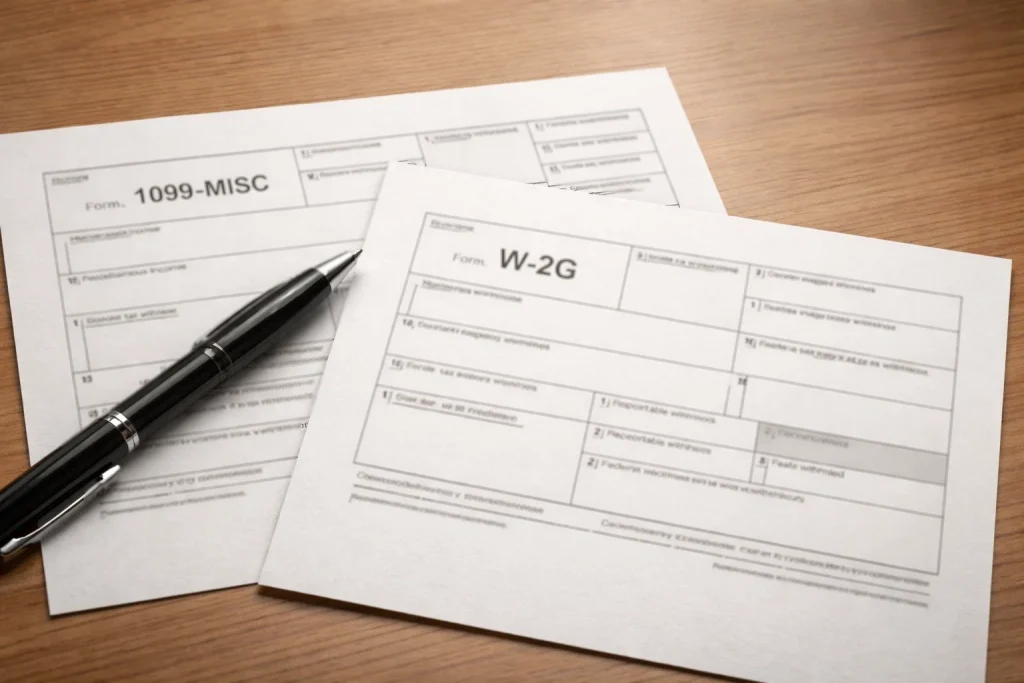
Why SC Redemptions Are Reportable
I am not a tax professional, and the specifics of your situation should go through someone who is. But the question comes up constantly, and it is worth addressing with the correct framing because most players carry an incorrect mental model into the first redemption of real size. The mental model goes: “I won this in a sweepstakes, and my tickets were free, so it is not taxable.” That model is wrong, and the mistake compounds the moment the dollar amounts get large enough that the IRS notices.
Sweeps Coins redemptions are reportable income under federal law. The underlying classification is the same as it is for any sweepstakes or lottery prize – you acquired a prize of monetary value through a chance-based mechanism, and when you convert that prize to cash, gift cards, or crypto, the conversion triggers a reporting obligation. The fact that the SC itself was acquired through free pathways does not change the reporting treatment of the redemption. What matters is the dollar value at the point of conversion, not the input cost on the SC side.
This is an area where the category’s “social gaming” framing has confused expectations. Operators rarely lead with the tax conversation, and the welcome-bonus pages never mention reporting thresholds. But the AGA data – 68% of players identify winning money as their primary goal, 90% view the activity as gambling – tells you that the tax treatment matches the gambling treatment, because the activity is structurally similar enough that the IRS does not care about the marketing wrapper. For any player redeeming meaningful amounts, understanding the reporting landscape before the first redemption is strictly better than understanding it after.
Read about state tax revenue lost to sweepstakes.
Federal Reporting Thresholds
The federal reporting threshold that most often matters for sweepstakes redemptions is $600. Under IRS rules, a payer (which for this purpose includes sweepstakes operators) is required to issue a 1099-MISC form for “other income” payments of $600 or more in a calendar year to a single recipient. That means if your cumulative SC redemptions at a single operator reach $600 in a year, the operator is required to file a 1099-MISC with the IRS reporting your winnings and to send you a copy for your records.
This threshold applies to cumulative annual amounts, not per-redemption amounts. If you redeem $200 in March, $200 in June, and $250 in September, your annual total at that operator is $650 – above the threshold – even though no individual redemption crossed $600. The operator is required to report the annual total.
A separate, higher threshold applies to specific gambling-winning categories under IRS rules. For slot machine and bingo winnings above $1,200 per event, operators use a W-2G form rather than a 1099-MISC. The W-2G is specifically for gambling winnings and carries somewhat different reporting requirements. Whether a sweepstakes operator uses a 1099-MISC or a W-2G depends on how the operator classifies the redemption internally. Some operators classify all SC redemptions as 1099-MISC territory; some classify slot-sourced redemptions above $1,200 as W-2G events. The specific treatment varies.
Regardless of which form the operator issues, the tax obligation on the player side is the same: the winnings are reportable on your federal return as income. The form the operator files determines what records the IRS has independent of your filing; it does not determine whether the income is taxable. It is taxable either way.
One common misconception: failure to receive a 1099-MISC does not mean the income is not reportable. You are obligated to report gambling winnings regardless of whether the payer issued a form. The form is a reporting mechanism for the payer’s compliance, not a safe harbor for the recipient.
Form 1099-MISC Vs W-2G Issuance Patterns
The distinction between 1099-MISC and W-2G is more than administrative. The two forms carry different withholding implications, different box placements for the income, and different intersections with other tax concepts. Knowing which form an operator will issue matters for planning.
1099-MISC is the broader category. It covers miscellaneous income from multiple sources – contractor payments, royalties, prizes, awards. Sweepstakes winnings fall under “other income” on a 1099-MISC. No federal withholding is typically applied by the operator; the full payout hits your bank account or gift card, and you are responsible for the tax at filing time.
W-2G is gambling-specific. It applies to winnings above certain thresholds ($1,200 on slots and bingo, $1,500 on keno, $5,000 on poker tournaments, others). For W-2G events, the operator is required to consider backup withholding – typically 24% federal – if the player fails to provide a valid Social Security number or makes specific attestations. Sweepstakes operators vary in whether they apply W-2G treatment to large single-event wins or classify everything as 1099-MISC.
For a player, the practical approach is to track every redemption in a simple ledger – date, operator, gross amount, payment method – regardless of whether a form is issued. At tax time, you aggregate the totals and report accurately. If you receive a 1099-MISC or W-2G from an operator, the numbers on the form should match your ledger for that operator’s redemptions. If they do not match, the operator’s records are what the IRS has, so reconcile with the operator before filing rather than disputing after.
Some operators issue tax forms late or inconsistently. A well-run operator sends 1099-MISC forms in late January for the prior calendar year. A less-organized operator might send them in March or not at all. Your filing obligation does not wait for the operator’s form. File based on your own records; if an operator-issued form arrives later and matches, you are fine; if it does not match, you may need to file an amendment.
State-Level Reporting Differences
Federal reporting is the baseline. State-level reporting varies, and for players in states with income tax, the state treatment of sweepstakes winnings layers on top of the federal obligation.
Most states with income tax treat gambling and sweepstakes winnings as taxable income at the state level, typically at the same rate as other income. A few states have specific provisions – New York, for example, has particular rules on gambling winnings that can affect how they are reported. States with no income tax – Florida, Texas, Tennessee, Nevada, Washington, South Dakota, Wyoming, Alaska, New Hampshire – obviously do not require state reporting of gambling or sweepstakes winnings, though federal obligations remain.
Deductibility of gambling losses against gambling winnings is another state-specific variable. Federally, gambling losses are deductible up to the amount of winnings, but only if you itemize deductions (not the standard deduction). At the state level, some states follow the federal treatment, some are more restrictive, some are more permissive. A player who itemizes and has both wins and losses during the year can sometimes reduce the effective tax burden meaningfully, but the specifics depend on state residency and the quality of record-keeping.
For players who redeem across multiple operators, the reporting burden is additive. A $400 redemption at one operator and a $500 redemption at another are each under the $600 federal 1099-MISC threshold – neither operator will issue a form. But your total gambling income for the year is $900, which is reportable in full. The lack of an operator form does not reduce the obligation; it just means the IRS has less independent documentation, which is good reason to keep your own records rigorously.
Connecticut’s settlement with High 5 Games for $1.5 million in May 2025 was not a tax case, but it illustrates how states are increasingly engaged with the category in ways that could extend to tax administration over time. State tax authorities have been tracking sweepstakes volume more actively as the category has grown. This is not a reason to panic, but it is a reason to treat the reporting obligation seriously from the start of your engagement with the category.
Record-Keeping Basics
The single most valuable thing a player can do for themselves tax-wise is maintain a simple record-keeping system from the first session. A spreadsheet with a few columns is sufficient. Date, operator name, transaction type (purchase or redemption), gross amount, payment method, notes.
What to record:
Every GC purchase, with the dollar amount paid and the GC/SC received. This is your input cost, which may be relevant if you are itemizing and deducting losses. For most players the standard deduction is better and input costs do not matter for federal reporting, but the records are cheap to keep and expensive to reconstruct retroactively.
Every redemption, with the gross SC amount redeemed and the net dollar amount received (which for most operators is the same, but gift-card redemptions sometimes carry discounts or premiums that make them different). Note the payment method and the clearing date.
Running annual totals by operator. This makes it trivial to identify which operators will likely issue 1099-MISCs and which will not, and it makes tax filing a transcription exercise rather than a reconstruction exercise.
The ledger does not need to be sophisticated. A Google Sheet or a notebook is fine. What matters is consistency – record at the time of transaction, not weeks later when the memory is fuzzy. For the broader operational context on how redemptions actually process and what happens between your redemption request and the money landing in your account, our redemption speed guide covers the mechanics.
Do new brands issue tax forms in the first year of operation?
In most cases, yes – established operators generally issue 1099-MISC or W-2G forms by late January for the prior calendar year. New brands in their first year of operation sometimes have less-polished tax-reporting operations, and forms can be delayed or arrive in less standard formats. Your federal reporting obligation does not wait for the operator"s form, so file based on your own records. If the operator-issued form arrives later and matches, the federal filing is clean; if amounts differ, an amendment or reconciliation may be needed.
Does a crypto redemption count the same as a cash one?
For federal income tax purposes, yes – a redemption to a crypto wallet is reportable at the US dollar value at the moment of redemption, the same way a PayPal or ACH redemption would be reported. The crypto wrapper does not change the classification. What crypto does introduce is a secondary tax event: if you later sell, exchange, or use the received crypto at a different dollar value, the gain or loss between receipt and sale is a capital gains event on its own track. A crypto-based player is potentially dealing with two tax events per redemption rather than one, which is another reason to keep careful records of the dollar value at the moment of each transaction.
See also: newest sweepstakes casinos — your sweepstakes casino centre.