
How New Brands Handle Account Closure and Balance Withdrawal
 Available in US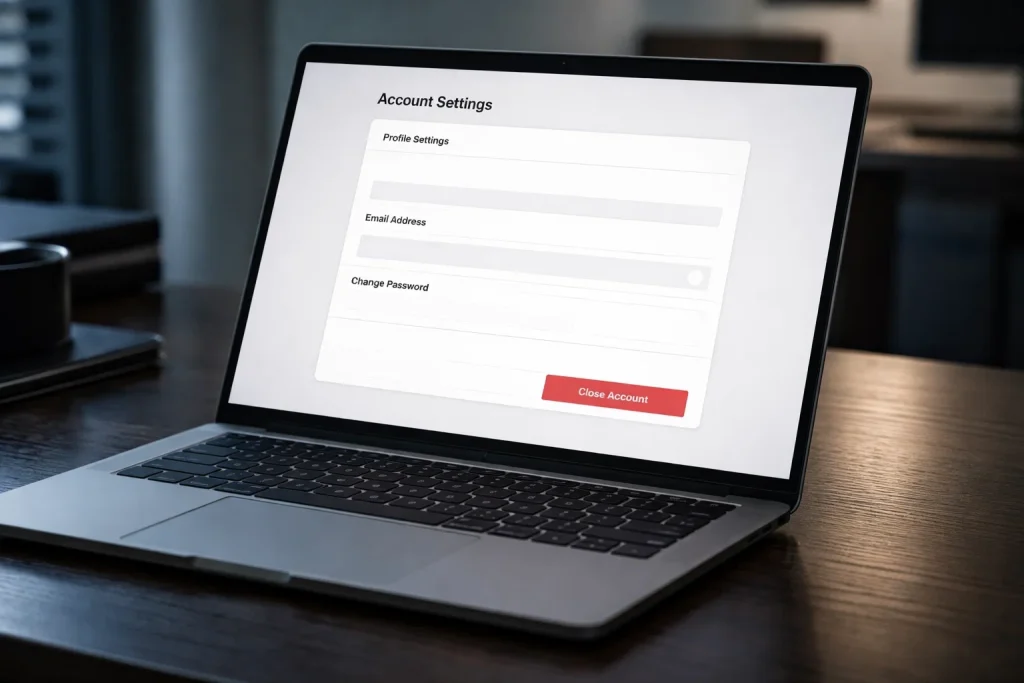
Why Closure Is The True Trust Test
The moment a sweepstakes casino’s real quality becomes visible is not the moment you create an account, and it is not the moment you win your first hundred SC. It is the moment you try to leave. The closure flow – how a brand handles a player walking away with or without a balance – is where every operational shortcut, every friction that was invisible during active play, and every promissory term in the T&C either holds up or collapses. I have watched brands that looked competent for months fall apart at the closure step, and I have watched brands that looked marginal in their first few weeks handle closure cleanly when the time came.
Account closure is underrated as a due-diligence signal partly because most players never reach that step. You create an account, you play for a while, you taper off, and eventually you forget the account exists. The closure flow sits unused in the product menu. But for players who are actively evaluating multiple new brands, closing an account at one brand to consolidate at another is a regular occurrence, and the quality of that flow directly affects whether you leave with your balance intact.
The 24-to-72-hour first-time KYC window applies to initial redemptions, but a different timer applies to closures. Closure-related redemption requests sometimes run slower than standard first-time KYC because the operator knows they are losing the customer relationship and has less incentive to prioritize the queue. This is not universal, but it is common enough that a player planning a closure should plan the redemption to happen well before the closure request, not simultaneously with it.
Read about terms and conditions at new sweepstakes casinos.
The Three Closure Paths
Account closure at new sweepstakes brands happens along three distinct paths, and the path determines what protections and procedures apply.
Path one is self-initiated closure. You log in, navigate to account settings, and select the option to close the account. Operators implement this very differently. At well-run brands, the self-closure flow is immediate – you click through a confirmation, the account closes, and you receive a confirmation email. At less-well-run brands, self-closure requires submitting a support ticket and waiting for operator review, which can take days and during which the account remains active. A true self-service closure button is rarer than it should be, but it exists at the more serious new operators.
Path two is site-initiated closure. The operator closes your account for reasons that include T&C violation (rule breaks, suspected fraud, abusive behavior), regulatory obligation (your state of residence becoming a ban state), or business decision (the operator exits a geographic market or discontinues a product feature). Site-initiated closures are communicated by email, usually with varying levels of detail about the reason. Some operators explain specifically; some cite generic T&C language without specifying which clause was triggered.
Path three is dormancy closure. If an account is inactive for an extended period – typically 6 to 12 months depending on the brand – the operator’s T&C usually empowers them to close the account and declare any remaining balance forfeit. This is the sneakiest closure path because it happens passively, without action from either side, and players often learn about it only when they try to log back in months or years later and discover the account is gone. The dormancy trigger is usually disclosed in the T&C but rarely proactively communicated through warning emails, so a player who has forgotten about an account can easily lose whatever balance was in it.
Each closure path has different implications for balance handling, which is the part of the process that most directly affects the player.
Remaining SC Balance Handling
What happens to your SC balance at closure depends on which path triggered the closure, what the balance composition is (real vs promotional), and what the operator’s policies specify.
For self-initiated closure with a remaining SC balance above the minimum redemption threshold, the standard flow at a reasonably well-run brand is: you initiate redemption for the SC, complete the KYC if not already done, receive the payout, and then close the account once the balance is at or near zero. Most operators allow this sequence and do not penalize you for redemption timing coinciding with closure intent. Some operators specifically include a closure-redemption flow that combines the two steps into one action.
For self-initiated closure with an SC balance below the minimum redemption threshold, the situation is worse. Most T&Cs state that balances below the minimum cannot be redeemed, which means a small residual balance has no cash-out path before closure. Some operators allow the residual to be forfeited (which the player accepts because the amount is usually small) or specifically offer small-balance redemption at closure with reduced fees or special mechanisms. The better operators include this; the typical operator does not.
For site-initiated closure where the operator has flagged the account for violations, the balance handling shifts substantially. If the violation is genuine (multiple-account creation, collusion, identity fraud), the operator typically reserves the right to forfeit the entire balance, not just the bonus portion. Players who are falsely flagged may be able to appeal, but the appeals process at new brands is often informal and inconsistent. For a player whose closure is operator-initiated and whose balance is substantial, the practical advice is to engage the operator’s support channel immediately, document every communication, and be prepared for a protracted process if the operator is unwilling to release funds.
For regulatory closure – your state becoming a ban state, for example – the California pattern from January 2026 is instructive. The seven confirmed ban states (California, Connecticut, Montana, New Jersey, New York, Indiana effective July 1, Maine) each produced a wave of closures handled in different ways by different operators. Some operators preserved balances and allowed out-of-state redemption; some paid out residual SC proactively; some forfeited small balances. Check the specific operator’s policy at the time the regulatory closure occurs, because the general category pattern is inconsistent.
For dormancy closure, balance handling is typically the harshest. Most T&Cs declare dormant-account balances forfeit, with no claim to the forfeited amount possible after closure. A player who reactivates a long-dormant account sometimes finds the balance has been zeroed out and there is no administrative path to recover it. This is legal under the operator’s terms but genuinely costs players who have drifted away from an account with a meaningful residual balance.
Data-Retention Policies Post-Closure
When an account closes, a separate question is what happens to the data the operator has collected about you. KYC documents, transaction records, identity verification, email correspondence, gameplay logs – all of this persists in the operator’s systems in some form after your account is no longer active.
Data retention policies at new sweepstakes operators vary widely and are rarely surfaced prominently. The privacy policy page usually contains some statement about data retention periods, but the specifics are often vague (“as long as necessary for business purposes” or “consistent with applicable law”). The better operators specify retention periods – “KYC documents retained for 5 years following account closure,” “transaction records retained for 7 years for tax compliance” – while the typical operator leaves the language open-ended.
The specific categories to be aware of:
KYC documents (ID photos, proof of address, selfies) are typically retained for legal-compliance periods of 5 to 7 years. The operator has regulatory and anti-money-laundering obligations that require document retention for extended periods after account closure. This is not optional at a well-run operator; it is required. The trade-off is that you cannot demand your ID documents be deleted at closure because the operator has a documented basis for continued retention.
Transaction records (deposits, wagers, redemptions) are usually retained for 7 to 10 years because of tax and audit obligations. If you later need a transaction history for tax filing purposes, this data persists and can be requested even post-closure.
Behavioral data and marketing communications are retained for variable periods depending on the operator’s analytics practices. Notably, closing an account does not automatically unsubscribe you from the operator’s marketing emails, which can continue for months if the operator’s systems do not update mailing lists based on account status. Unsubscribe separately from closing.
Reopening An Account After Closure
The rules around reopening a closed account depend on why the account was closed in the first place, and this is an area where operator policies differ substantially.
For self-initiated closure without any T&C issues, reopening is usually possible and straightforward. Contact support, request reactivation, complete any re-KYC that the operator requires after the closure period, and the account returns to active status. Balances are rarely restored to their pre-closure state if any forfeiture occurred, but the account itself can be reopened and used going forward. Some operators require a specific cooling-off period (30 days, 60 days) between closure and reopening to discourage casual closure-reopening cycles.
For site-initiated closure due to T&C violations, reopening is typically not possible. The operator’s violation flag persists on your identity (your name, address, or payment method, depending on how the flag is implemented), and attempts to create a new account at the same brand are rejected by the same flag. Some players have reported success contacting support with additional documentation or clarification, but this is a longshot rather than a reliable path.
For self-exclusion closure, reopening is intentionally harder. The whole point of self-exclusion is to make the decision sticky – a 12-month self-exclusion should not be reversible after 3 weeks. Well-run operators enforce the exclusion period strictly and refuse reactivation attempts during the window. Less-well-run operators sometimes allow reactivation on request, which undermines the responsible-gaming value of the self-exclusion tool. If responsible gaming is your reason for closure, choose an operator with a well-implemented self-exclusion mechanism; if that is not available, consider device-level blocking tools that do not depend on the operator’s cooperation.
For dormancy closure, reopening is often possible but starts from scratch – no balance restoration, no VIP tier preservation, no historical transaction access beyond what the operator’s data retention allows. You are effectively starting a new relationship with the brand under your old identity. This is usually the easiest closure path to reopen from, but the least valuable because nothing from the previous relationship carries forward.
For the broader view on how first-redemption mechanics interact with the account lifecycle at new brands, our redemption speed guide for new sweepstakes casinos covers the KYC and payout timing that shape the closure flow when a balance is involved.
How long must I be inactive to be marked dormant?
Dormancy thresholds vary by operator but typically sit in the 6-to-12-month range. Some brands flag accounts as dormant after 90 days of no login activity; others wait a full year. The specific threshold is disclosed in the T&C, usually in a section about account maintenance or inactivity. If you plan to return to a brand after a long break, log in at least once every few months to reset the dormancy clock, even if you are not depositing or playing. A login counts as activity at most operators and preserves the account status.
Can I reopen an account after voluntary self-exclusion?
In general, not during the exclusion period itself – that is the entire point of the tool. A 1-year self-exclusion should block reopening for at least 12 months from the exclusion start date. After the exclusion period ends, most operators allow reopening but typically require a cooling-off step and sometimes re-KYC. Some well-implemented self-exclusion programs require active reactivation after expiration rather than auto-reopening, which is a stronger protective design. If you self-excluded for responsible gaming reasons, use the cooling-off period to genuinely reconsider whether reopening is a good idea, rather than treating the expiration as an automatic return.
See also: newest sweepstakes casinos — the sweepstakes casino guide.