
Where You Can Play New Sweepstakes Casinos in 2026: A State-by-State Legality Map
 Available in US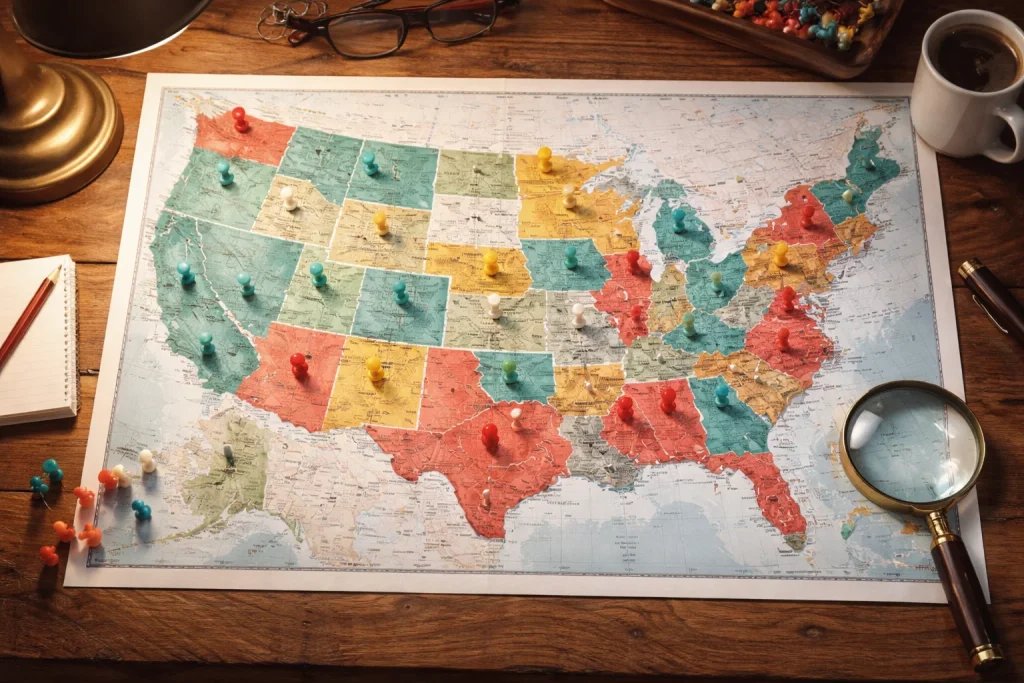
Why the Map Redrew Itself Between 2024 and 2026
Two years ago the map of US states where you could register at a sweepstakes casino had maybe three or four holes in it. Today it has seven confirmed bans, at least five states where cease-and-desist letters are actively thinning the operator list, and a widening middle band where the legal status depends on which attorney general you ask and which week you ask them. The geography of this industry has redrawn itself faster than any US gaming vertical I have covered.
The catalyst everyone points to is California’s Assembly Bill 831, which Governor Gavin Newsom signed on October 11, 2025. The legislature passed it without a single dissenting vote — 36 to 0 in the Senate, 63 to 0 in the Assembly — and it banned dual-currency sweepstakes operators across the state effective January 1, 2026. California represented roughly 17.3 percent of US sweepstakes sales in 2025, with projected volume of $2.42 billion. Losing it in one stroke moved the center of gravity for the entire national market. By April 2026, seven states had confirmed bans on the books: California, Connecticut, Montana, New Jersey, New York, Indiana effective July 1 of this year, and Maine.
This piece is the legality guide I wish I had written a year ago, because the map kept moving and nothing on the open web kept up. I have organized it around the three buckets that actually matter when you are evaluating a newly launched operator — banned, gray, and green — and added the legal reasoning each attorney general has leaned on, because understanding the theory tells you which states are likely to move next. Nothing here is legal advice; I am an industry analyst, not your lawyer. But the framework below is the same one I use to judge whether a new brand’s state list is honest or wishful.
Read about the California AB 831 aftermath.
How State Law Classifies a Sweepstakes Casino
Every state attorney general who has moved against sweepstakes operators has built the case around the same three-legged stool. Get one leg wrong and the whole structure falls over, which is why operator legal teams spend so much energy arguing about definitions that sound pedantic until you realize millions of dollars turn on them.
The three legs are consideration, chance, and prize. Magnus Boberg, who founded JustGamblers and has tracked the argument from the operator side, framed the structural defense simply: traditional gambling requires three elements — consideration (payment), chance, and prize — and sweepstakes sites do not require payment, so they bypass regulations that apply to traditional online gambling. The entire dual-currency architecture exists to sever the consideration leg. You can always obtain Sweeps Coins through AMOE without paying anything, and because of that, the argument goes, no payment is ever truly required.
State AGs moving to shut down operators have attacked this defense on two fronts. The first attack argues that “payment” is too narrow a definition of consideration, and that the effort of completing a meaningful AMOE request — handwriting a postcard, mailing it, waiting for processing — is itself a form of consideration even when no money changes hands. This argument has not yet held up cleanly in court, but it has scared enough operators into exiting states where the AG signals that the theory will be tested.
The second attack is more surgical: the attorney general concedes the AMOE path exists but argues that the Sweeps Coins purchased inside Gold Coin packages are themselves the “consideration” because players are effectively paying to receive the redeemable currency. New York Attorney General Letitia James put the second theory in its tightest form in her June 2025 cease-and-desist letters: betting cash-redeemable virtual coins on games of chance constitutes gambling, regardless of how the casino operator characterizes how players can obtain the virtual coins. That single sentence is the foundation under half the enforcement actions in the current US map.
What matters for players evaluating a new operator is the legal posture of their home state. States that buy the “no consideration” defense leave operators alone. States that attack it through the AMOE-isn’t-really-free route push brands into a gray zone where the SC path is partially restricted. States that accept James’s “cash-redeemable is always gambling” framing ban the product outright. The bucket a state falls into tells you whether a newly launched brand claiming to operate there is being accurate or is waiting for a knock on the door.
The Seven Confirmed Banned States in 2026
As of April 2026, seven states have put statutory bans on the books that specifically target dual-currency sweepstakes operators. Every reader should have this list memorized before touching a newly launched brand, because the state you live in is the first question any new site’s registration flow should be asking.
California ended the sweepstakes era within its borders on January 1, 2026. AB 831 did more than ban new launches — it required every existing operator to exit the state completely, taking their Sweeps Coin liability with them. Because California was 17.3 percent of the national market and represented $2.42 billion in projected annual volume, the exit was the single largest market contraction any US gaming vertical has seen in a decade.
Connecticut signed SB 1235 into law, and the Department of Consumer Protection reached a $1.5 million settlement with High 5 Games over its sweepstakes casino product in May 2025. The Connecticut ban is narrower in language than California’s but broader in enforcement posture — the state moved first with private settlements, then with legislation, and has signaled that new operators attempting to launch without dual-currency modifications will not be tolerated.
Montana passed SB 555, banning online sweepstakes gaming through an amendment to the state’s existing gaming code. The practical effect was minimal — Montana was never a major sweepstakes market — but the speed of passage mattered politically, because it showed that even small states with no existing iGaming framework could move against the category without legislative friction.
New Jersey passed A5447, and the bill’s presence in a state with a massive regulated iGaming industry sent the clearest possible signal: the regulated casino lobby views sweepstakes as a direct revenue competitor and will spend political capital to squeeze it out. The SPGA pushed back publicly, arguing in an August 2025 statement that members operate within well-established legal frameworks, pay appropriate taxes, and adhere to a strict code of conduct, and that instead of working collaboratively to establish clear modern rules for platforms that offer free-to-play games and do not require a purchase to win, the state had opted for overreach. The legislature passed the bill anyway.
New York enacted SB 5935 and, separately, the attorney general’s cease-and-desist action in June 2025 drove 26 online sweepstakes operators out of the state ahead of the statute itself. New York was an estimated $762 million sweepstakes market in 2024, which puts it second only to California in lost revenue for operators. The combination of executive action and subsequent legislation made New York the first major state where the industry effectively lost before the law required it to.
Indiana passed HB 1052, effective July 1, 2026. New brands launching this spring into the Indiana market know the meter is running — any operator who has not figured out a geo-blocking and account-closure plan by late June will be scrambling. The statute gives the Indiana Gaming Commission explicit authority to pursue unlicensed operators civilly and criminally, which is a higher enforcement ceiling than most of the other state bans.
Maine’s LD 2007 rounded out the seven. The law’s text leans heavily on the AMOE-isn’t-really-free argument, which makes it the cleanest test case for what happens if an operator actually challenged the definition of consideration in court. None has, and most have simply added Maine to their geo-blocking list.
The states above are the closed cases. Every other state on the US map is either actively green — meaning new operators can launch there with minimal regulatory friction — or actively gray, meaning enforcement is happening without a statutory ban on the books. The gray zone is larger than most players realize.
The Gray-Zone States Where Enforcement Is Active but Law Is Not Yet Written
A state without a sweepstakes ban on the books is not necessarily a safe state. The gray zone — where enforcement is active but the statute does not specifically name the category — is where most of the drama of the last eighteen months has played out, and it is also where the greatest risk sits for players who sign up with a new brand today and wake up to a forced account closure next month.
Illinois is the loudest gray-zone example right now. Illinois regulators sent cease-and-desist letters to 65 sweepstakes operators in February 2026, one of the largest single-state crackdowns on record. There is no Illinois statute specifically banning dual-currency casinos — the regulator is leaning on the existing gaming act and arguing that sweepstakes operations fall within the act’s definition of unlicensed gambling. Sixty-five letters is a lot of paper. The practical effect is that many brands that previously accepted Illinois players have quietly dropped the state from their lists without announcing the change publicly.
Louisiana is the other loud example. The Louisiana Gaming Control Board issued cease-and-desist letters to 40 offshore wagering and sweepstakes operators in June 2025. Chairman Christopher Hebert framed the enforcement posture in direct terms: Louisiana would not tolerate illegal operators who put citizens at risk and undermined the fairness and integrity of the gaming industry, and that the state would continue to use every enforcement tool available. Louisiana AG Liz Murrill followed with a formal legal opinion on July 2, 2025, stating that it was the opinion of her office that online businesses offering casino-style games — purporting to be sweepstakes or social gaming platforms — were operating in violation of Louisiana law. No Louisiana statute specifically names the category, but the combined pressure from the LGCB and the AG’s office has emptied the state of most major operators.
Minnesota sits a step behind Louisiana. AG Keith Ellison issued public statements in November 2025 that online platforms offering sportsbooks and casino games run by out-of-state and overseas operators may make it look as though online gambling is legal and safe in Minnesota, but that it was not, and that trying to rebrand poker chips as virtual currencies did not change the fact that the operations were unlawful. The Minnesota Alcohol and Gambling Enforcement Division’s Director Carla Cincotta made clear that failure to comply with Minnesota law or cease operations in the state would impact future licensing decisions. Minnesota has not passed a sweepstakes-specific statute, and enforcement is currently through warning letters rather than active litigation, but the signal is clear.
Mississippi is running a purely regulatory strategy. The Mississippi Gaming Commission press release from June 2025 cautioned citizens from engaging with any online site that offered gambling opportunities, because the player could be subject to criminal prosecution and forfeiture of money deposited with the site, and that these sites often promoted themselves as legal when there were no legal exceptions for online sportsbooks or so-called sweepstakes casinos. The language matters — Mississippi is warning players, not just operators, which is a tactic the state uses when statutory authority is ambiguous.
The pattern across all four states is the same. No statute names the sweepstakes category directly, but the executive or regulatory branch treats the product as a form of unlicensed gambling under existing law, and operator response is almost always to geo-block rather than fight. The practical outcome for players is that a new brand claiming to accept Illinois, Louisiana, Minnesota, or Mississippi residents today may not accept them in a month. If you live in one of these states, read the operator’s state list before depositing, and check it again before every redemption.
The Clear-Green States Where New Operators Freely Launch
Roughly 33 states fall into the clear-green bucket where new sweepstakes operators can launch without a realistic enforcement threat. These are the states doing the heavy lifting for industry volume, and they are the states where the 25-plus new brands that launched in 2025 have concentrated their marketing spend.
Texas is the largest green-zone prize by population and arguably the most watched. The Texas legislature has floated sweepstakes-related bills multiple times without passage, the Texas Lottery Commission has not moved against the category, and the state’s general prohibition on gambling has not been extended to dual-currency platforms. Operators treat Texas as a strategic anchor — losing Texas would reshape every national marketing plan. As of April 2026, Texas remains open.
Florida is the second-largest prize and also the most politically complex. The Social Gaming Leadership Alliance’s December 2025 economic impact report estimated that Florida accounted for 8.5 percent of US sweepstakes operator revenue in 2025 — more than $1 billion in purchases — with a potential 6 percent tax yielding $63 million in state revenue if regulated. That framing matters because it gives Florida legislators an explicit alternative to banning: tax it instead. No ban has been enacted, no major enforcement action has been taken, and the tribal gaming lobby in Florida is not positioned as aggressively against sweepstakes as California’s was. Florida is open, but it is the green-zone state most likely to move into gray territory during 2026.
Georgia, Ohio, Pennsylvania (despite a regulated iGaming framework), Virginia, North Carolina, and most of the Midwest outside Indiana and Illinois sit comfortably in green territory. Operators launching in 2026 almost universally accept players from these states without caveats, and enforcement actions against sweepstakes in any of them have been absent or cosmetic.
What makes a state green rather than gray is not the absence of any statute — most states have gambling laws broad enough to be stretched toward sweepstakes if an attorney general wanted to — but the absence of political will to stretch them. A green state has either a regulatory agency that sees sweepstakes as outside its mandate, an attorney general with other priorities, or a legislature comfortable with the revenue mix as it stands. That balance can shift, and the operators know it. When you see a newly launched brand opening 2026 registration in 35 or more states, it is betting on the green-zone map staying green for at least another marketing cycle.
The broader context is worth holding in mind. US regulated gaming generated $1.54 billion in gaming tax revenue in a recent tracking period — a 9.8 percent year-over-year increase — but that figure is impacted by untaxed sweepstakes operators operating in the green zone without any state revenue contribution. Every new brand that launches in a green-zone state adds to the untaxed pile, and every dollar in the untaxed pile adds pressure on legislators to move the state out of green territory.
California AB 831: The January 2026 Shutdown Explained
The ten weeks between Governor Newsom’s signature on October 11, 2025 and the January 1, 2026 effective date were the strangest stretch of the US sweepstakes industry’s recent history. Operators knew the exit date. Players knew the exit date. And yet new brands kept launching in California right up to the deadline, milking the last drops of a $2.42 billion projected market that was about to vanish. Victor Rocha, who chairs the Indian Gaming Association’s conference, put the mood of the closing weeks bluntly: the industry wasn’t built to last, it was all about the arbitrage, operators knew the flimsy house of cards would eventually collapse, and now the game was about disgorgement — thinking of all those beautiful dollars coming back to the people of California.
The bill itself passed with zero opposition — 36 to 0 in the Senate, 63 to 0 in the Assembly — and the vote margins told you everything about the political coalition that assembled behind it. Tribal gaming interests, the regulated card-room lobby, consumer-protection advocates, and the state’s gaming regulators all lined up on the same side. Sweepstakes operators had no legislative champion because the revenue they were generating never flowed into California’s tax base, and the one argument that might have moved a few legislators — that banning the category would eliminate a consumer-facing product without replacing it with a regulated alternative — was blunted by California’s existing ban on online iGaming, which meant there was no regulated alternative to channel players toward in the first place.
The mechanics of the shutdown mattered as much as the statute. AB 831 did not give operators a transition window to wind down balances. It banned the product, and every operator accepting California residents had to execute a full exit by December 31, 2025. Sweeps Coin balances held by California players at midnight had to be either redeemed, voided, or transferred to an out-of-state account the player separately qualified for. Most operators chose a combination of accelerated redemption processing in the final week and a forfeiture clause for anything still unclaimed at the stroke of midnight. A handful offered balance transfers to sister-site accounts registered in other states, though only players with valid non-California residency could use that path.
The national revenue implications rippled out for months. Because California was 17.3 percent of the US market, every brand’s Q1 2026 revenue dropped sharply even without any player behavior changes elsewhere. Operators who had over-indexed on California marketing spent Q4 2025 scrambling to redirect acquisition dollars to Texas, Florida, and the Midwest. The brands that launched in the last eight weeks of 2025 chose their initial state lists knowing California was lost — which explains why every 2026 launch I have reviewed has Texas and Florida at the top of its state-priority list, not California.
What Geo-Blocking Actually Does When a New Brand Launches
Geo-blocking is the technical layer that translates legal language into player-visible behavior, and it is messier than most players realize. When a new brand says it does not operate in New York, what that actually means depends on which IP-geolocation provider the operator uses, how aggressively the provider flags VPN traffic, and whether the operator layers additional checks on top of the baseline IP lookup.
The standard stack at a new brand has three layers. The first is IP geolocation at registration, which catches the player whose IP address places them inside a banned state and blocks the signup form from submitting. The second is IP geolocation at login, which catches the player who registered elsewhere and is now logging in from a banned state’s IP. The third is payment-address matching at KYC, which catches the player who registered from a non-banned state IP but submitted identity documents showing an address in a banned state. Each layer has different false-positive and false-negative rates, and operators tune the stack to balance enforcement strictness against legitimate-user friction.
The practical effect for players is that geo-blocking is rarely a binary “allowed” or “not allowed” — it is a spectrum of what actions are permitted and where. A player who registered in a green state and later moves to a gray state may be able to keep playing and redeeming until the next time the operator re-verifies address, which can be triggered by any redemption above a threshold, by a routine KYC refresh, or by an account-review flag unrelated to geography. Moving physically between green states generally causes no issue. Moving between green and banned states almost always causes some disruption.
VPN detection is the layer that causes the most player frustration and the one that newest brands have been most aggressive about. A 2026 launch running the Maxmind or IPQualityScore geolocation stack will flag an estimated 95 percent of consumer VPN traffic at login and block the session. The remaining 5 percent — usually residential-proxy services — trigger behavioral flags that propagate to fraud review and typically end with account closure rather than silent blocking. Every operator I have reviewed in the last year explicitly voids winnings associated with accounts flagged for VPN use, and the clause lives in the terms-of-service section most players never open.
What geo-blocking does not do is protect an operator from legal exposure if the blocks fail. When Indiana’s HB 1052 takes effect on July 1, 2026, an operator whose geo-stack lets 2 percent of Indiana registrations slip through is still exposed to enforcement. That is why the state-ban list drives exit decisions rather than just technical blocks — the cheapest legal posture is “we don’t operate there at all,” not “we operate there imperfectly.”
Tribal Gaming Pressure and Why It Shapes the Map
You cannot read the state-by-state map without reading the tribal gaming lobby’s fingerprints on most of it. California’s AB 831 passed unanimously because tribal interests had spent years building the coalition that made passage inevitable. Connecticut’s enforcement posture reflects the Mashantucket Pequot and Mohegan tribes’ vocal opposition to unregulated competitors. Indiana’s HB 1052 picked up momentum after the Pokagon Band weighed in on behalf of regulated gaming. The tribes are not hiding their role — they are proud of it, and they are organized.
Dan Hartman, a senior advisor at GMA Consulting and the former director of Colorado’s Division of Gaming, summed up the tribal position at an NCLGS conference in 2025: the one thing he had said all along is that you cannot all break in through the back door, because companies pay a lot to get licensed and do the things they do in a given state. That framing is the tribal argument in miniature. Tribal casinos operate under compacts negotiated with state governments, pay substantial revenue shares, fund regulatory oversight, and employ thousands of people whose jobs depend on the compact structure. A sweepstakes operator offering functionally similar games without any of those obligations is, in the tribal reading, a free rider on the regulated market.
The economic argument lands hardest in states where tribal revenue is a meaningful contributor to state budgets or to tribal-community services. California’s tribes fund education, health care, and infrastructure from gaming revenue. Florida’s Seminole Tribe has a long-running compact dispute that intersects with sweepstakes policy. New Mexico’s tribes have been quietly lobbying for enforcement even without a specific statute on the books. Every state where tribal gaming is politically powerful is a state where the sweepstakes map is either already banned, actively gray, or primed to move.
The pattern is predictive. If you want to guess which state will move next, look at the ratio of tribal gaming revenue to state budget, then look at whether that state’s attorney general has made public statements about unregulated operators in the last twelve months. When both arrows point up, the state is a candidate for the next round of enforcement actions. This predictive frame has held up consistently across the 2024 to 2026 cycle, and I expect it to hold through 2027 as well.
The counterpressure comes from industry trade groups — the Social Gaming Leadership Alliance (SGLA) and the Social and Promotional Games Association (SPGA) — and from the economic argument that banning the category loses more tax revenue than it recovers. SGLA executive director Jeff Duncan framed the collaborative alternative in June 2025: the SGLA remained committed to collaborative engagement with New York officials to develop balanced regulations that served the interests of consumers, the state, and the digital entertainment industry, and believed productive dialogue could lead to solutions enhancing consumer protection while supporting innovation. That pitch has landed with almost no legislators so far. Tribal interests are organized, the sweepstakes industry’s policy posture is fragmented, and the state map shows which side is winning.
Questions Readers Ask About New Operator Legality
Four questions land in my inbox almost every week about state-level legality. The short answers are below; for the broader context on where new operators sit across the entire US landscape, the complete guide to the newest US sweepstakes casinos pulls the whole picture together.
Can I use a VPN to play at a new sweepstakes casino from a banned state?
Technically possible, practically disastrous. Modern geo-stacks at new operators flag roughly 95 percent of consumer VPN traffic at login, and most terms of service explicitly void winnings associated with accounts detected using a VPN. Even if you slip past the login check, the KYC process will usually require an address and payment details that match a non-banned state, and any mismatch triggers fraud review. The combination of technical detection, contractual voiding, and state-level enforcement exposure makes the practical expected value of VPN play sharply negative.
If a state only sent cease-and-desist letters, does that mean sweepstakes casinos are illegal there?
Cease-and-desist letters are a regulator"s opinion, not a court ruling. A C and D letter states that the attorney general or gaming commission believes the operator is violating existing law, and operators typically comply by exiting the state rather than fighting the legal theory in court. That means the practical answer is usually that the category is not allowed there even though no statute specifically names it. Illinois, Louisiana, Minnesota, and Mississippi all sit in this posture as of April 2026.
Will my existing Sweeps Coins balance transfer if a new brand exits my state?
It depends on the operator"s exit plan. California"s January 2026 exit saw most brands offer an accelerated redemption window in the final two weeks, after which unclaimed balances were either voided or forfeited per the terms of service. A few operators with multi-state networks allowed balance transfers to sister-site accounts registered in non-banned states, but only when the player could independently verify residency elsewhere. The safe assumption: when a state ban is announced, plan to redeem before the exit date rather than betting on a transfer.
Why did so many new brands launch just before California"s ban took effect?
Arbitrage economics. California represented 17.3 percent of the US sweepstakes market, and the ten weeks between Governor Newsom"s October 2025 signature and the January 2026 effective date were a known window of captive demand. New launches could extract meaningful acquisition volume during that window even knowing the market would vanish, and the operators who launched into it were trading short-term California revenue for brand recognition they could carry into other states once California closed.
See also: newest sweepstakes casinos — your complete guide to new sweepstakes casinos.