
Dual-Currency Mechanics: Gold Coins vs Sweeps Coins for First-Time Players
 Available in US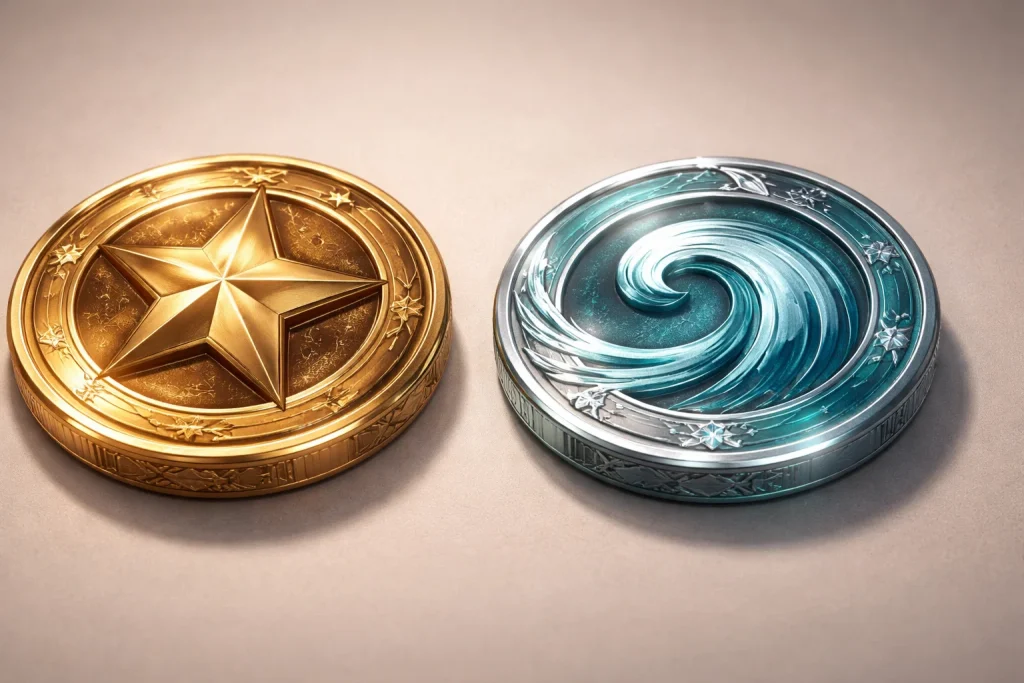
Two Tokens, Two Different Purposes
The question I get more than any other from first-time players: “If I am buying Gold Coins, why did the operator also give me Sweeps Coins, and which one is actually the money?” It is a fair question, and the answer is not intuitive until you see the two tokens as completely separate products that happen to share a user interface.
Gold Coins and Sweeps Coins are not denominations of the same currency. They are two different things with two different legal statuses, two different use cases, and two different bankroll rules. A Gold Coin is a play chip that cannot be redeemed for anything. A Sweeps Coin is a promotional entry that can be redeemed for cash prizes once a few conditions are met. They share a slot catalog, they share an account, they share a payment screen — and that is where the confusion starts. The AGA survey that covered 2,250 players found that 95% of sweeps users consider the Sweeps Coins layer important to the product, with 42% calling it “extremely important.” That ratio tells you which coin they actually care about, even if they are nominally paying for the other one.
If you understand which coin is doing what at every moment — which you are spending, which you are accumulating, which one will eventually pay out — the rest of the sweepstakes model stops being confusing. If you do not, you will either redeem too early, play too cautiously, or spend money assuming you are wagering when you are not.
Understand sweepstakes vs social casinos in 2026.
Gold Coins: The For-Fun Currency
Start with what a Gold Coin is. It is a virtual token used to play games in “social mode.” You can buy Gold Coins in packages — a $9.99 bundle, a $49.99 bundle, a $199.99 bundle — or earn them through daily login bonuses, mini-games, referrals, and sometimes social media follows. Once credited, Gold Coins sit in your GC balance and can be wagered on any slot or table the brand offers, at stake sizes denominated in GC.
What Gold Coins cannot do: redeem to cash. There is no pathway. GC-mode wins produce more GC, which you can keep playing with or watch depreciate as you lose interest. The purchase is structurally similar to buying coins in a mobile game — you are paying for entertainment, and the entertainment ends when you stop playing or close your account. No refunds, no redemptions, no conversion.
This is where the operator’s core economics live. Most of what US players spent on Gold Coin packages in 2024 — an estimated $8.5 to $10.6 billion, depending on the measurement frame — stayed in the GC column, because most GC packages never get fully played down and most GC that does get played loses its nominal value on the reels. Gold Coins are the revenue product. The fact that they are legally characterized as a purchase of play chips, not a wager, is what keeps the whole sweepstakes model outside traditional gambling statutes in states where the model still operates.
One detail that trips people up: every GC package sold usually comes with a small bundle of free Sweeps Coins attached. That is the legally required “Alternative Method of Entry” structure surfaced as a promotion. You did not pay for the SC. You paid for the GC and got the SC for free with no purchase required — a fact that matters to lawyers and matters to your bankroll, because those free SC are the ones you can actually redeem.
Sweeps Coins: The Redeemable Layer
Sweeps Coins are the other half of the product. An SC is a promotional sweepstakes entry denominated at roughly 1 SC = $1 USD at redemption, provided you meet the operator’s playthrough requirement — usually 1x, meaning you need to wager the SC at least once through the games before cashing out. A small number of brands apply a 3x requirement instead, which materially changes the math.
You cannot buy Sweeps Coins. There is no button labeled “Buy SC.” You can only acquire them through no-cost pathways: the free SC attached to GC purchases, the welcome bonus, daily logins, mini-game drops, social contests, and the postal AMOE request that any legitimate operator must honor. The distinction between “bundled free with a purchase” and “purchased” is legal, not semantic. If an operator sold SC directly, the structure would collapse into straight gambling and lose its statutory standing in most of the states where it operates.
Sweeps Coins can be wagered on the same games as Gold Coins, in a separate mode. The slot result uses the same RNG either way, so the math is the same, but only SC-mode winnings count toward redeemable balance. When you accumulate enough SC — typically a minimum of 50 to 100 SC, depending on the brand — and have cleared the playthrough requirement, you can submit a redemption request for cash, gift cards, or in some cases stablecoin crypto. At Chumba specifically, the minimum is 100 SC with no crypto support; the pathways are PayPal, ACH, and Visa gift cards.
Your SC balance is the entire game, from a bankroll perspective. GC is inventory you are consuming for entertainment; SC is the asset that converts to dollars. First-time players who confuse the two spend GC aggressively to “win more SC” and come away frustrated because the win-rate on the SC side is independent and the GC session is not buying them prize potential.
Why Operators Structure It This Way
Strip away the marketing and the dual-currency model is a legal architecture, not a product preference. The reasoning comes from the three-element test for gambling under US law: consideration, chance, and prize. Traditional gambling requires payment as consideration to enter a game of chance for a prize. Knock out any of those three and the activity is no longer gambling in the statutory sense.
Sweepstakes casinos knock out the first element. The GC purchase is framed as buying entertainment — play chips for a social game — not as paying to enter a wagering contest. The free SC attached to that purchase, plus the mail-in AMOE path for anyone who does not want to buy GC at all, means there is a zero-cost pathway to the prize layer. Because that pathway exists, the prize layer is technically a promotional sweepstakes, not a bet. The dual-currency design is what keeps the walls between those two layers legally visible.
The regulatory pushback on that framing has been the 2025–2026 story. California’s AB 831 took effect January 1, 2026, explicitly banning the dual-currency model in the state regardless of how free the SC acquisition path claims to be. New York’s attorney general sent cease-and-desist letters to 26 operators in June 2025 and all 26 ended SC sales in New York. By April 2026, seven states — California, Connecticut, Montana, New Jersey, New York, Indiana (effective July 1), and Maine — have confirmed bans. The list is growing. State-by-state detail sits in our legal states map for 2026.
For everywhere sweepstakes casinos still operate, the dual-currency structure is load-bearing. That is why no operator will sell you Sweeps Coins directly, why every brand surfaces an AMOE path even if nobody uses it, and why the free-with-purchase SC bundle is never described as a discount on a wagering token.
Playing Modes In Practice
Inside the app, switching between GC and SC mode is usually a toggle at the top of the game client. Same game, same reels, same volatility — different currency and different implications. What actually changes when you flip the switch:
In GC mode, stakes are denominated in GC, wins are paid in GC, bonus features award GC multipliers. Nothing about the session can produce redeemable value. You are playing for entertainment and for the GC balance itself. There is no playthrough to worry about, no redemption math to calculate, no KYC check to clear before you spin.
In SC mode, stakes come out of your SC balance, wins credit SC, and bonus features award SC. Every SC you wager counts toward playthrough on any unlocked balance. If you hit a meaningful win in SC mode, it becomes part of the bankroll you will eventually redeem, subject to verification — KYC at first redemption typically takes 24 to 72 hours, and that is true across the category, not just at brand-new operators. Most players hold a small SC balance most of the time, because SC accumulates slowly through free pathways. That is normal. A healthy session is one where you extend your SC balance a little, not one where you treat SC spins as a replacement for GC play.
The practical approach that works for first-time players: use GC mode to explore the catalog and find games you enjoy. Use SC mode only for games you already know from GC sessions, at stakes you have tested in GC first. The math is identical across modes, but the emotional stakes are not — nobody enjoys spinning away their redeemable balance on an unfamiliar slot. Save the exploration for the free-to-play side.
Can I buy Sweeps Coins directly?
No. There is no operator in the category that sells Sweeps Coins as a standalone purchase, and it is the part of the model that has to stay in place. SC is acquired through no-cost paths: the free bundle attached to GC packages, daily logins, mini-games, welcome bonuses, and the mail-in AMOE. If a site ever offers a direct SC purchase button, that by itself is a red flag worth stepping away from.
Do I lose my Gold Coins if I switch to Sweeps mode mid-session?
No. Your GC balance and SC balance are stored separately and persist across mode switches. Flipping to SC mode pulls from the SC balance only; your GC balance sits untouched and is waiting when you switch back. The only way to lose GC is to wager it down in GC mode or to hit a balance-forfeiture trigger in the terms — long inactivity, account closure, or a violation — which applies to both columns equally.
See also: newest sweepstakes casinos — your sweepstakes casino portal.