
Responsible Gaming Tools at Newly Launched Sweepstakes Casinos
 Available in US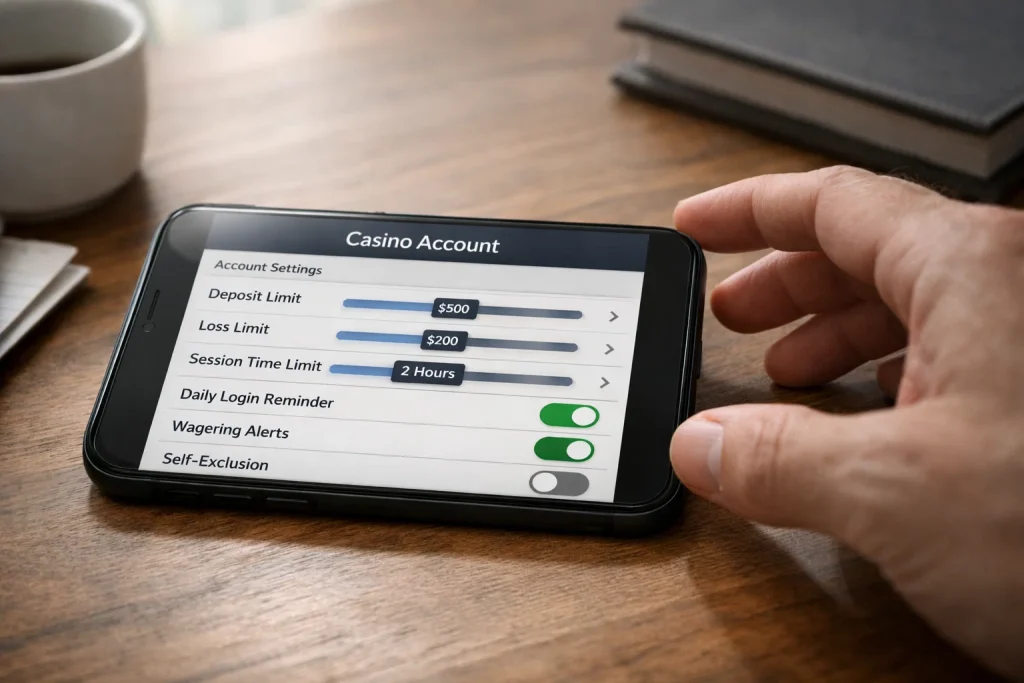
Where Sweeps Brands Still Lag Licensed Ones
If you open the responsible gaming page at a licensed online casino in New Jersey and at a newly launched sweepstakes brand in the same week, the contrast is immediate. The licensed page is long, specific, linked to state-run resources, and structured around tooling the operator is legally required to provide. The sweeps page is often shorter, vaguer, and built around a single 1-800 number and a self-exclusion checkbox that may or may not work as advertised.
The gap is not a design choice by individual sweeps operators. It is a consequence of the regulatory posture. Licensed iGaming operators have to provide specific responsible gaming tooling because state regulations require it. Sweepstakes operators – operating outside that regulatory framework – provide the tooling they choose to provide, and the choices vary enormously across brands. The AGA survey that found 90% of US sweepstakes casino players consider playing on these platforms to be gambling also found that 68% say their primary goal is to win money. An audience that sees itself as gambling, playing for money, deserves tooling calibrated to that reality rather than to a “social gaming” framing the product abandoned years ago.
The brands that are taking responsible gaming seriously in 2026 are doing so for strategic reasons, not regulatory ones. They are positioning for a possible regulated future in which sweepstakes becomes a licensed category in some states, and they want to already have the tooling in place when that transition comes. The brands that are still phoning it in are betting that the regulatory environment will not change fast enough to punish them for the gap. Players do not need to take that bet. The tooling you need is available – unevenly – and the brands that provide it are worth identifying before you start playing seriously.
Read about account closure at sweepstakes casinos.
Deposit And Purchase Limit Tooling
The first tool on any responsible gaming checklist is the ability to cap your own purchase activity. At licensed iGaming operators, this is mandated: deposit limits must be configurable by the player, must be enforced in real time, and must include a cooling-off period before a limit can be increased. The limit-increase friction – typically 24 hours between requesting a higher limit and having it take effect – is the key protective feature, because it prevents the kind of in-the-moment decision that the limit was designed to guard against in the first place.
At new sweepstakes brands, the deposit-limit picture is mixed. Better brands provide daily, weekly, and monthly GC purchase caps that users can set in their account settings. The caps are enforced at the checkout layer – if you try to buy a $50 GC package with a $30 daily limit, the transaction fails. Limit increases typically require a cooling-off period, though the specific length varies across operators from a few hours to a full week.
Weaker implementations are common. Some brands offer “limits” that are requested through support tickets rather than set in self-service settings, which introduces friction that defeats the tool’s purpose. Some provide a daily limit but not a weekly or monthly. Some enforce the limit at the account level but allow circumvention through multiple payment methods or multiple sessions. These implementations exist, and they are the ones most players do not discover until they have tried to use them in a moment when the discovery matters.
A small number of new brands provide particularly strong deposit tooling – real-time limits across all payment methods, self-service setting with documented cooling-off periods, optional “loss limits” that cap the amount you can lose per session rather than the amount you can deposit. These are the operators worth identifying in advance. Check the responsible gaming page of a brand before registration, not after, because the feature set varies in ways that are hard to reverse-engineer once you are committed to a platform.
Self-Exclusion At A Brand-New Operator
Self-exclusion is the mechanism by which a player voluntarily bars themselves from an operator for a specified period – typically 30 days, 6 months, 1 year, or permanent. At a well-implemented operator, self-exclusion closes account access entirely for the duration, refuses new account creation using the same identity, and typically forfeits any pending promotional credit.
At new sweepstakes brands, self-exclusion tooling ranges from genuinely functional to borderline ornamental. Functional self-exclusion at a serious operator works like this: you click the self-exclusion option in your account settings, confirm the duration, complete a brief confirmation (sometimes including an SMS or email confirmation code), and the account is closed immediately. Access is blocked at the IP level, device level, and account level. Attempting to create a new account with the same name, address, or payment method is refused.
Less functional self-exclusion involves requesting closure through a support ticket, waiting for operator review, and receiving confirmation days later. During the interim, the account remains active. This is self-exclusion in name only, because the friction between the moment of decision and the moment of enforcement is exactly the period in which the player is most vulnerable to reconsidering.
The most important feature of self-exclusion at any operator is irreversibility. Once self-excluded, the player should not be able to unilaterally undo the decision, especially not through routine customer service channels. Brands that allow easy self-exclusion reversal – a support chat that reactivates the account “on request” after a few hours – are running a self-exclusion feature that is functionally decorative. Verify this quality before relying on it.
Cross-operator self-exclusion, which exists in regulated iGaming markets through programs like GamStop in the UK or state-level registries in several US states, does not exist for sweepstakes. If you self-exclude at one sweepstakes brand, you have not excluded yourself at the sister site under the same parent, and you certainly have not excluded yourself category-wide. This is a meaningful gap that no new brand can close unilaterally, and it is one of the structural responsible-gaming weaknesses of the sweepstakes category as a whole.
Session Timers And Reality Checks
Session timers – notifications that remind you how long you have been playing – are a mid-tier responsible-gaming feature. Licensed iGaming operators typically offer configurable session timers that pop up at 30-minute or hour-long intervals, summarizing time played and net balance change. The pop-up is a pause point, not a forced action, but the pause itself is the protective value.
At new sweepstakes brands, session timers are present at serious operators and absent at weaker ones. The better implementations let you configure the interval and the content – time-played, balance change, a combination. The weaker implementations offer a single fixed interval or a generic “you have been playing for 30 minutes” notification without any actionable summary. The ornamental implementations offer nothing and rely on device-level screen-time tools to provide the equivalent functionality outside the app.
Reality checks are a stronger version of session timers – periodic pauses that require the player to acknowledge before continuing play. Some operators run reality checks at 30-minute intervals by default for new users, gradually extending as the account demonstrates stable play. This is a rare feature at sweepstakes brands but appears at the more responsible-gaming-forward operators.
For a player who values this tooling, the practical approach is to check specific operator documentation before signing up. The responsible gaming page lists the tools the operator provides; the account settings page shows where those tools are configured. Brands that provide real tooling make it discoverable. Brands that provide ornamental tooling tend to bury it or leave it unmentioned.
External Resources And Cross-Operator Blocks
The last tier of responsible-gaming tooling is the external-resource layer – links and referrals to organizations outside the operator that provide support for players struggling with their relationship to gambling. This is where the sweepstakes category has its widest gap from the regulated iGaming baseline.
Licensed iGaming operators in the US link prominently to state-specific problem gambling resources, to the National Council on Problem Gambling (1-800-GAMBLER), and sometimes to third-party tools like GamBan that can block access to gambling sites at the device level. The resources are listed on the responsible gaming page, in the account settings, and often in in-game notifications when session timers trigger.
At sweepstakes brands, the external-resource layer is thinner. The better operators link to 1-800-GAMBLER and to the National Council on Problem Gambling. The weaker operators provide a single generic 1-800 number and no additional referrals. A few brands that position themselves as responsibility-forward include links to device-level blocking tools and to financial counseling resources that address gambling-related debt specifically – these are the exceptions rather than the norm.
For any player who has concerns about their own play, the external resources are worth knowing about independently of which operator you use. The National Council on Problem Gambling operates the 1-800-GAMBLER helpline and maintains a directory of state-specific resources that is more complete than any individual operator’s referral list. Device-level blocking tools exist as standalone products and can be used independently of any operator cooperation – if you decide that sweepstakes play is not working for you, you can take action without waiting for an operator’s tooling to meet you halfway. For the broader picture of how to evaluate a new brand’s operational seriousness on every dimension, our verification framework for new brands covers the adjacent structural signals.
Does self-exclusion at one new brand carry to sister sites?
Generally no. Self-exclusion is typically enforced at the individual brand level, not at the parent-company or cluster level. If you self-exclude at one Blazesoft brand, for example, you are not automatically self-excluded at other Blazesoft-affiliated brands. A small number of operators have implemented cluster-wide self-exclusion within their own portfolios, but this is the exception rather than the norm. There is no industry-wide cross-operator self-exclusion program for sweepstakes casinos comparable to what exists in several regulated iGaming markets.
Are 1-800 helplines integrated at launch?
Usually, yes – the 1-800-GAMBLER number or a similar helpline link is standard on the responsible gaming page at new sweepstakes brands. The question is less whether the number is listed and more whether it is surfaced in a way that is discoverable when a player needs it. Some brands display the helpline prominently across the site; others bury it in a footer that most users never scroll to. The visible surface area of the responsible-gaming infrastructure is a useful signal of how seriously the operator takes this layer.
See also: newest sweepstakes casinos — your go-to sweepstakes casino site.