
VIP and Loyalty Tiers at Recently Launched Sweepstakes Brands
 Available in US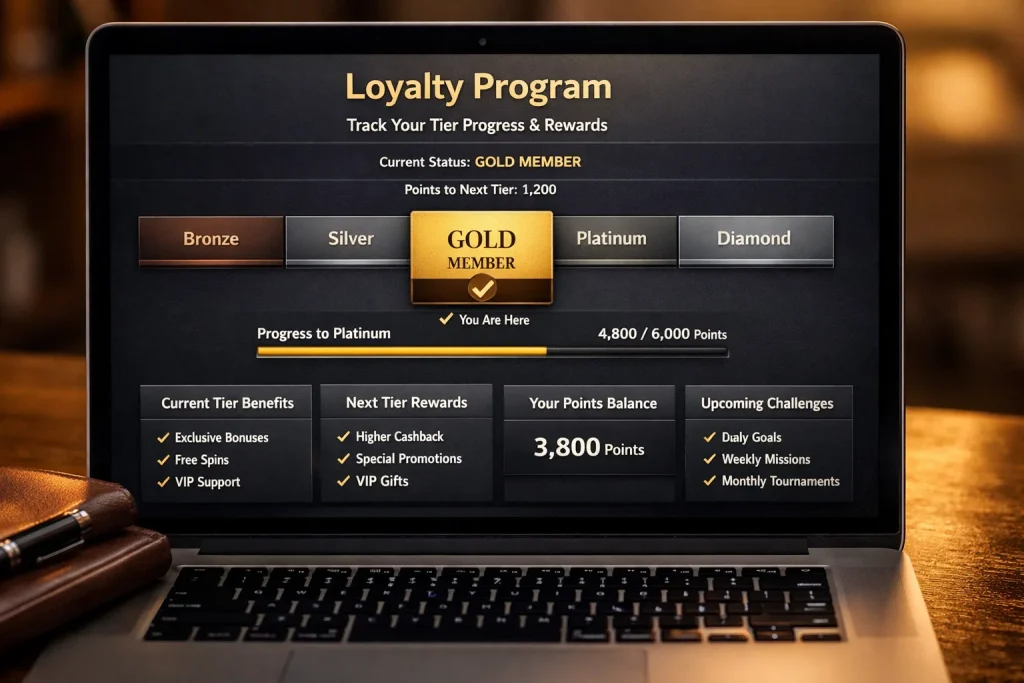
Loyalty Programs As A Retention Weapon
Loyalty programs at new sweepstakes brands are not a courtesy. They are an economic weapon built to solve the single hardest problem in the category: keeping a player engaged past month three, when the novelty of the brand has faded and every competitor is one app-switch away. A well-designed VIP program changes a player’s mental model from “I am trying this brand” to “I have status here,” and that shift is worth substantial recurring revenue to the operator.
The aggressive VIP programs at newer brands are a direct response to the market structure. VGW’s Chumba runs a competent but understated loyalty program; new brands competing for VGW’s existing mid-VIP players have to offer measurably better return on the same spend to poach them. That competitive pressure has pushed newer brands toward more generous VIP math than the category showed three years ago. The AGA survey data – 95% of sweeps players call SC important, 42% call it extremely important – tells you what the VIP program is really trading in. These are not loyalty points that cash out to merch. These are multipliers on the redeemable layer.
The catch is that most players underuse VIP programs in the same way they underuse daily login bonuses. The math is there, but it requires commitment and record-keeping to extract. A VIP program is only worth what the player understands about it, and the breakdown that follows is the structural math that most operator marketing pages will not put in plain language.
Check out daily login bonuses at new sweeps casinos.
How VIP Points Are Earned In Sweeps Mode
Every VIP system in the category keys off some version of “play volume” – the more you wager, the more status points you accumulate. The specific accrual rate varies, but the most common structure runs something like: 1 VIP point per 10 GC wagered in GC mode, or per 1 SC wagered in SC mode. The SC ratio is typically 10x the GC ratio because SC has redeemable value – the operator wants to reward players who carry engagement into the redeemable layer more than players who only wager GC.
Some brands weight points by game type. Slots accrue at the base rate; table games at 25% to 50% of the base rate; live-dealer tables sometimes at 50% to 100% of the base rate. The reason is margin – slot volatility is higher and the operator’s expected take per wagered dollar is larger, so slot wagering “deserves” more points in the operator’s accounting. A player who specializes in low-house-edge games like blackjack accrues status more slowly than a slot player with equivalent turnover.
Bonus bets – wagers funded by promotional SC or free spins – sometimes count for VIP points and sometimes do not. At most brands, bonus wagers count at a reduced rate, usually 25% to 50% of the base accrual. A few brands exclude bonus wagers from VIP accrual entirely. Check the specifics if you are strategizing around a welcome bonus period.
Points usually reset monthly or quarterly for tier calculation – meaning your current tier is based on your recent activity, not your lifetime total. A player who hits a high tier in January and then plays lightly through February will typically demote by March. This is the operator’s defense against players who make a single large deposit to reach a tier and then coast on the benefits. It also means sustained engagement matters more than occasional bursts.
Tier Benefits In Practice
The benefits stack across tiers in a predictable shape. Entry-level tiers offer modest perks – slightly larger daily login bonuses, occasional reload offers, priority support queuing. Mid-tiers add measurable cashback – typically 5% to 10% of net SC losses returned weekly or monthly – along with increased redemption limits and faster KYC processing for repeat redemptions. Top tiers stack dedicated account management, custom bonus structures, VIP-only tournaments, and redemption priority that can cut payout times noticeably.
Cashback is the benefit that most consistently matters. A 10% weekly cashback on net losses at a mid-tier VIP program effectively increases your SC-mode RTP by about 10 percentage points on sessions where you finish underwater. That is meaningful compounding across months of play. A player running 96% RTP slots with 10% cashback on losses is playing at an effective RTP closer to 99% to 100% depending on variance, which is well above the operator’s stated edge.
Dedicated account management – the top-tier perk – sounds more impressive than it usually is. At most brands, the “account manager” is a CRM staffer who runs templated outreach to top-tier players, offering occasional custom bonuses and flagging your redemptions for priority processing. At a handful of larger brands, the role becomes more substantive – genuine relationship management, custom deposit-matched offers, and operational support that a regular-tier player does not receive. Distinguishing the genuine from the templated version takes a few months of observation.
Redemption priority is undervalued as a benefit. A standard new-brand first-time KYC cycle runs 24 to 72 hours; a VIP-flagged redemption can cut that to the same-day window. On repeat redemptions, VIP status can mean same-hour payout rather than next-day. For players who redeem frequently, this operational difference is worth more than a marginal cashback increase would be.
Comparing VIP Programs At New Brands
The surface comparison of VIP programs is usually about tier names and benefit lists. The underlying comparison is about two numbers: points-per-dollar-wagered and cashback-per-net-loss. Everything else is decoration.
A generous new-brand VIP program might offer 0.1 VIP points per SC wagered and 15% cashback at mid-tier. A modest program offers 0.05 points per SC and 5% cashback at a similar tier. The generous program is roughly twice as valuable in pure math terms. Tier names – “Silver Elite” versus “Gold Master” – do not factor into the comparison.
The less-visible factor is tier qualification thresholds. Two programs can offer identical cashback rates at “mid-tier” but require different monthly spend to reach that tier. A program that requires $500 of monthly GC spend to reach 10% cashback is substantially harder to break even on than a program that requires $200 of monthly GC spend for the same cashback rate. The ratio of cashback percentage to tier qualification dollars is the cleanest single metric for comparing VIP programs.
New brands in 2025-2026 have competed aggressively on these thresholds because the competitive pressure is highest at the launch stage. A brand trying to establish itself will often lower tier thresholds – or increase cashback at the same threshold – for its first six months of operation, then quietly tighten the program once it has a stable VIP cohort. Players who join a new brand’s VIP program during the launch window sometimes keep grandfathered terms as the program tightens, though this varies by operator.
Cross-brand VIP loyalty does not work. Even within the same parent company’s portfolio, VIP status at one brand does not carry to a sister site. Each brand runs its own program independently. The only category where cross-brand status matters is when an operator specifically announces a portfolio-wide VIP program, which a few clusters have experimented with but none have made foundational.
When A VIP Program Actually Pays Off (Break-Even Math)
Whether a VIP program is worth chasing depends on your baseline activity, not the program’s advertised benefits. The break-even question is: at what level of play does the VIP cashback exceed the time cost and deposit concentration required to earn it?
Worked example. Assume a brand offers 10% weekly cashback on net SC losses at a mid-tier reached by wagering 5,000 SC per month. A player wagering 5,000 SC per month on 96% RTP slots loses an expected 200 SC per month to the house edge. The 10% cashback on those losses is 20 SC per month, or roughly $20 of recovered redeemable value.
Is 20 SC per month worth targeting? The question has a few layers. If you were already wagering 5,000 SC per month, the 20 SC cashback is pure addition – net-positive, easy decision. If you were wagering 2,000 SC per month and you would need to increase play to 5,000 SC to hit the tier, you are adding 3,000 SC of exposure to capture 20 SC of cashback, which is a poor trade because the 3,000 SC of additional wagering will lose an expected 120 SC to the house edge that you would not otherwise have lost.
The cleanest rule: chase a VIP tier only if you already wager at or near the qualification threshold organically. Do not increase play to reach a tier; the house edge on the incremental play exceeds the cashback value. This is the single most important VIP math point for a player to internalize, and it is also the one that operator marketing is most silent on.
For the broader structural context on how welcome bonuses, daily logins, and VIP programs stack together at a brand’s launch window, see our no-deposit bonus breakdown for new US sweepstakes casinos.
Do VIP tiers reset monthly at new brands?
In most cases, yes – tier calculation typically runs on a rolling monthly or quarterly window based on recent activity. If your VIP points accrued in January put you at a mid-tier, but you play lightly in February, you will typically demote by the March tier check. The reset protects the operator from players who front-load a month of high activity to claim a tier and then coast. A small number of brands use a lifetime-points model with permanent tier placement, but this is the exception in the 2025-2026 launch cohort.
Can VIP status carry between sister sites?
At almost no brand. Even within the same parent company"s portfolio, VIP status is program-specific. You are a top-tier VIP at one brand, starting from scratch at the sister site. A handful of operators have experimented with portfolio-wide VIP programs – unified status across multiple brands in the cluster – but these are exceptions, and when they exist, they are usually announced prominently because the operator wants the retention benefit of a visible unified program. If the VIP page does not mention portfolio-wide status, assume it is brand-specific.
See also: newest sweepstakes casinos — your sweepstakes casino portal.