
Sweepstakes Casinos vs Social Casinos: Category Definitions for 2026
 Available in US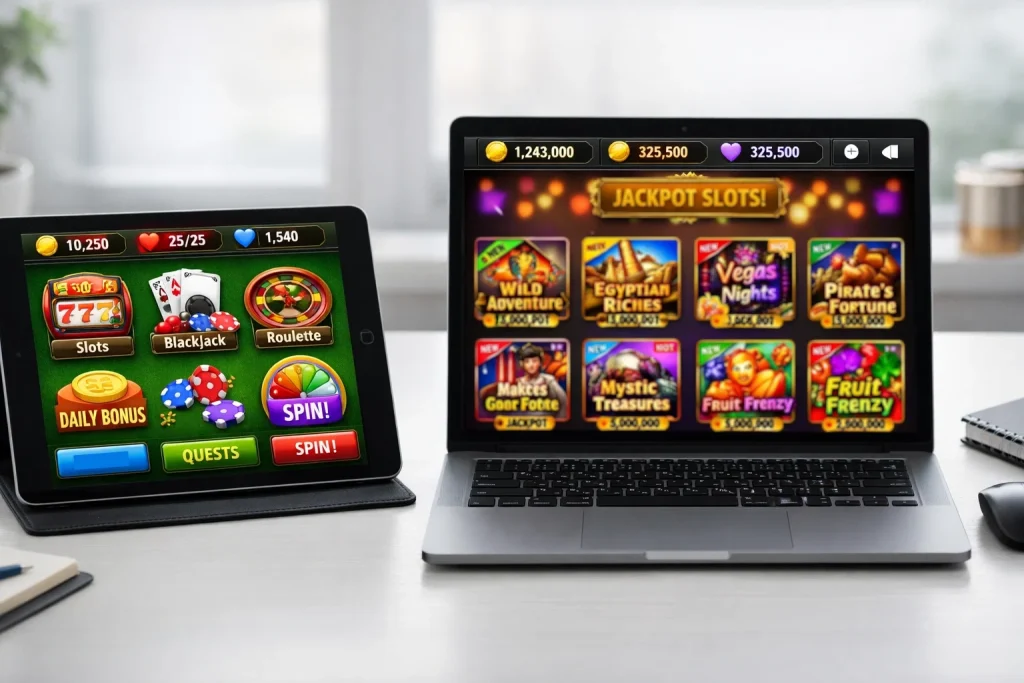
Overlapping Terminology, Different Products
A reader asked me last month whether Chumba was a social casino or a sweepstakes casino. The correct answer is both, depending on which layer of the product you are looking at. That answer is unsatisfying, but it also happens to capture the definitional mess that the category has lived with for a decade and a half. Two distinct product models share a lot of surface area, and the language conventions people use to describe them are inconsistent across operators, marketing channels, and legal frameworks.
In 2026, the distinction matters more than it used to. State enforcement actions turn on whether a given product qualifies as one or the other, and the answer affects which statute applies, which state it can operate in, and what risk the operator takes on. A pure social casino can continue operating in states that have banned sweepstakes casinos. A sweepstakes casino cannot. For a player, the distinction sets the expectation of whether money can come back out of the product.
Magnus Boberg, founder of JustGamblers, laid out the underlying logic plainly in a 2025 interview: “Traditional gambling requires three elements: consideration (payment), chance, and prize. Sweepstakes sites do not require payment, so they bypass regulations that apply to traditional online gambling.” That three-element test is the analytical backbone for distinguishing the two product types. Everything else is downstream of which elements each model includes or excludes.
Understand gold coins vs sweeps coins.
Social Casino: The Non-Redeemable Model
A social casino is, at its core, a mobile or web game that lets you play casino-style games – slots, poker, blackjack, roulette – using a virtual currency that has no cash value and cannot be redeemed for anything. You can buy more of the currency to extend play, but the currency never leaves the game. Winning at a social casino produces more of the same non-redeemable currency; losing means you play less until you buy more or wait for daily bonuses.
The business model is identical to mobile gaming more broadly. Players pay for entertainment, the entertainment runs in virtual currency, the operator’s revenue comes from in-app purchases of currency bundles. Companies like Playtika, Zynga, and SciPlay have built substantial businesses on this model – social casino is a multi-billion-dollar global category independent of the sweepstakes niche.
Legally, social casinos fall outside gambling statutes in virtually every US jurisdiction because the prize element is missing. You cannot “win” anything of monetary value from a pure social casino, so the statutory gambling definition does not apply. This is why social casino operations continue in California, New York, and other states that have banned sweepstakes casinos – the legal framework for banning social casinos would need to target in-app purchases for virtual currency, which legislators have not seriously attempted.
Pure social casino apps exist alongside the sweepstakes category but serve a different audience purpose. A player at a pure social casino is there for entertainment value, social competition (leaderboards, friend challenges), and the slot-machine-style dopamine loop, not for the possibility of cashing out. The retention mechanics are designed around mobile-gaming conventions – daily rewards, virtual achievements, progress systems – rather than the redemption logic that drives sweepstakes engagement.
Sweepstakes Casino: The Redeemable Layer
A sweepstakes casino layers a redeemable currency – Sweeps Coins – on top of a social-casino-style base experience. The GC mode of a sweepstakes casino is functionally a social casino: buy Gold Coins, play slots, win more Gold Coins, none of it redeems. The SC mode is the differentiator: wager Sweeps Coins, win more Sweeps Coins, redeem SC for cash or prizes once you meet playthrough and minimum redemption thresholds.
The dual-currency structure is the legal architecture that keeps the model outside traditional gambling statutes. Because SC cannot be purchased directly – it must be acquired through no-cost pathways like AMOE, daily logins, or free bundles attached to GC purchases – the “consideration” element of the gambling three-element test is missing in theory. The activity is characterized as a promotional sweepstakes, not a wagering game.
That framing has held up in some states and collapsed in others. The collapse has accelerated in 2025-2026. Seven states have confirmed bans – California, Connecticut, Montana, New Jersey, New York, Indiana (effective July 1, 2026), and Maine – by rejecting the consideration-free defense and classifying the SC layer as wagering regardless of how the SC is acquired. The debate that determined those bans was specifically about the sweepstakes model, not about social casinos, which have been left untouched.
For a player, the practical distinction is about what happens when you accumulate wins. At a social casino, wins extend your play session and nothing more. At a sweepstakes casino, SC wins become a potential future cash payout – a $30 accumulated SC balance converts to roughly $30 in PayPal or ACH once playthrough is cleared and KYC is completed. The presence or absence of that redemption pathway is the entire difference between the two product categories.
Hybrid Brands That Offer Both
Some operators run hybrid products that function as social casinos for players in banned states and as sweepstakes casinos for players elsewhere. The brand’s code base is the same; the feature availability is geo-gated at login. A New York resident accessing the site sees a social-casino-only experience with GC mode active and SC mode hidden or disabled. A Florida resident accessing the same site sees the full dual-currency product.
This is the compliance posture most large operators have taken in response to state-level bans. Rather than exit the banned state entirely, they strip out the redemption layer for residents of that state and continue operating the social side. The math of this posture is marginal – as I noted earlier, GC-only mode is lower-margin than the full dual-currency model – but it preserves the customer relationship and keeps the brand visible in case state policy changes.
Hybrid brands are legally clean in each state where they operate, provided the geo-gating works correctly. The social side is subject to social casino rules (effectively none in most states); the sweepstakes side is subject to sweepstakes rules in states where those rules permit the model. The legal risk comes from execution failures – a New York resident who accidentally sees SC functionality, or a Louisiana user who slips past the geo-block through a VPN – which is why operators invest heavily in IP geolocation accuracy and residency verification.
The category’s long-term trajectory may push more operators toward hybrid-heavy models rather than pure sweepstakes. If additional states ban the dual-currency model in 2026-2027, the practical choice for a national brand is to run social-only in more states and sweepstakes-enabled in fewer, rather than exit the banned states entirely. The operator’s US footprint becomes a patchwork of product variants keyed to individual state policies.
Why The Distinction Matters Legally
The sweeps/social distinction is the pivot point for almost every enforcement action in the category. A state AG considering sweepstakes regulation has to draw a line somewhere, and the line is almost always at the redemption layer. Social casinos without redemption are left alone; sweepstakes casinos with redemption are targeted.
This creates a specific policy question that state legislatures and AGs have not uniformly resolved. California’s AB 831 targeted dual-currency sweepstakes casinos specifically, leaving social casinos untouched. New York’s AG action targeted SC redemption specifically. Louisiana’s AG opinion framed both sweepstakes and some social-adjacent models as problematic but focused enforcement on the sweeps operators. Other states have drawn the line differently, and the result is a regulatory patchwork in which the same operator might face enforcement in one state for a product feature that is entirely legal in another.
For operators planning a 2026 launch, the distinction shapes the product roadmap. A pure social casino can launch in all 50 states with minimal regulatory risk. A sweepstakes casino can launch in 33-plus states but must actively monitor for state-level changes that would force a product-level exit. A hybrid can launch in both categories but accepts the engineering complexity of maintaining two product modes.
For players, the legal distinction translates to what you can expect from the product. A social casino will never pay you cash. A sweepstakes casino can, subject to the usual verification and playthrough requirements. A hybrid brand’s behavior depends on your state, which is worth checking at registration rather than assuming. The broader picture of what “new” means in 2026 across both product categories lives in our 2026 launch calendar for new sweepstakes brands.
Are social-only apps banned in the same states as sweepstakes?
Generally no. The state bans in effect through April 2026 – California"s AB 831, New York"s AG action, Louisiana"s opinion, and the similar measures in Connecticut, Montana, New Jersey, Indiana, and Maine – have targeted the dual-currency sweepstakes model specifically. Pure social casinos without a redemption layer have not been subject to these bans. A social casino app that accepts in-app purchases for non-redeemable virtual currency operates legally in all 50 US states under current law. That could change if states decide to regulate social casinos, but as of early 2026 it has not.
Can a social casino become a sweepstakes casino mid-launch?
Technically yes, but the operational reality is more complicated. Adding a sweepstakes redemption layer to an existing social casino requires substantial changes – payment processor relationships, KYC vendor integration, sweepstakes rules publication, compliance infrastructure for state-level geo-gating. Operators that have added an SC layer to an existing social product typically announce it as a major update rather than a quiet feature addition, and the rollout takes months rather than weeks. It is more common to launch as a sweepstakes casino from the start than to convert mid-lifecycle.
See also: newest sweepstakes casinos — your sweepstakes casino resource.